
International Examination
Collaborative Online Learning Program
Joint Degree and Double Degree
Short Mobility Program
SDG Film Festival
Study Abroad
Unit B-23 Jalan K.H. Mas Mansyur Kav. 35, Jakarta Pusat 10220, Indonesia
T: (021) 5794 3751
F: (021) 5794 3752M: +62 815-1305-3559 / +62-815-1305-1344
E: [email protected]
IG:lspr.international
LSPR and THUAS Students Tackle Global Megatrends in Successful 5-Week Intercultural COIL Project
LSPR Institute of Communication & Business has completed the five-week Collaborative Online International Learning (COIL) project in collaboration with The Hague University of Applied Sciences (THUAS), Netherlands, that was held for five weeks, starting from November 18th to December 16th, 2025. The project had 18 postgraduate students from LSPR Institute and 20 students from Facility Management, The Hague University of Applied Sciences. The class was held via Zoom and comprised an international team of students to study the link between UN megatrends and sustainable futures.
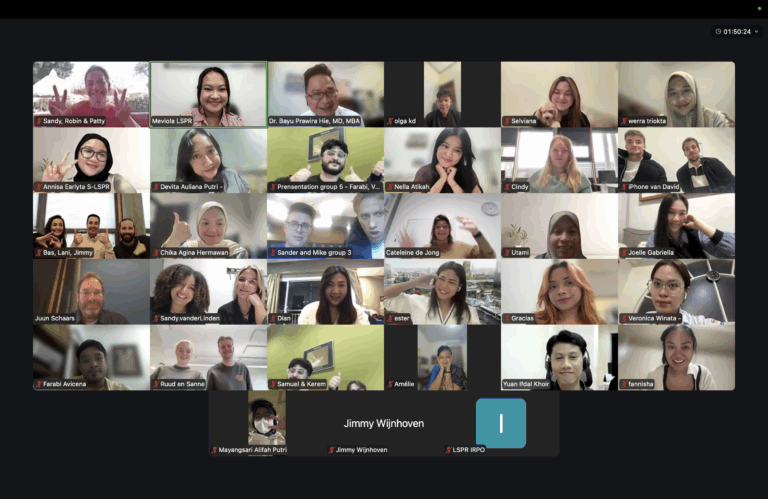
This program was initiated through a kick-off session involving interaction facilitated by Dr. Bayu Prawira Hie, MD, MBA from LSPR, Mr. Juun Schaars and Ms. Cateleine de Jong from THUAS. The participants were grouped into nine teams made up of individuals from different countries in order to provide a platform where they could initiate channels of communication and allocate themselves roles for their research process. Additionally, all participants were able to share their cultural views and experience life in Indonesia and the Netherlands.
For the purposes of upholding academic rigor in the process, a coaching workshop took place on December 2 for students prior to their submission of work. Facilitators helped students refine research questions by relating evidence to the broader perspectives of technology and sustainability. Through this important step in the project, students were encouraged to move beyond superficial assumptions and to conduct deep comparative analysis in consideration of the distinct socio-economic and environmental conditions in Dutch and Indonesian societies.
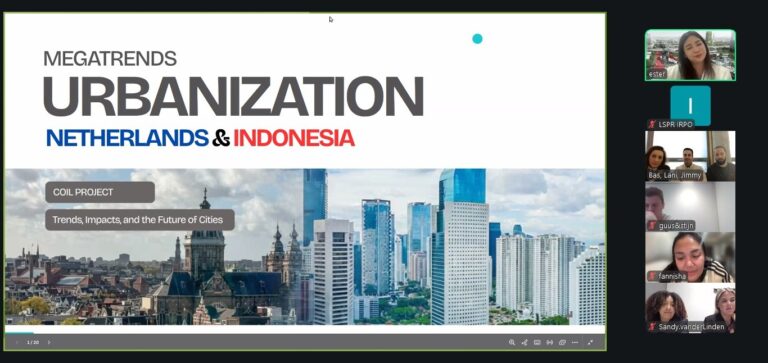
The project ended on December 16, where there were final presentations to be assessed by the combined panel of three lecturers consisting of Dr. Bayu Prawira Hie (LSPR), Mr. Juun Schaars (THUAS), and Ms. Cateleine de Jong (THUAS). The nine groups of students had to deliver their comparative analysis supported by data mapping and research paper presentations and then answer the questions from the audience. At the end of this curriculum, all participants had to submit a reflection about their communication techniques.
The success of COIL clearly showed that in order to address complex problems of the world, one needs to combine both excellent analytical abilities and cultural intelligence. The ability to look at technological and environmental problems from different cultural perspectives helped the participants acquire important cross-cultural competencies as well as virtual teamwork skills. Such collaborative efforts have successfully prepared these young people to be globally competent professionals in the future.